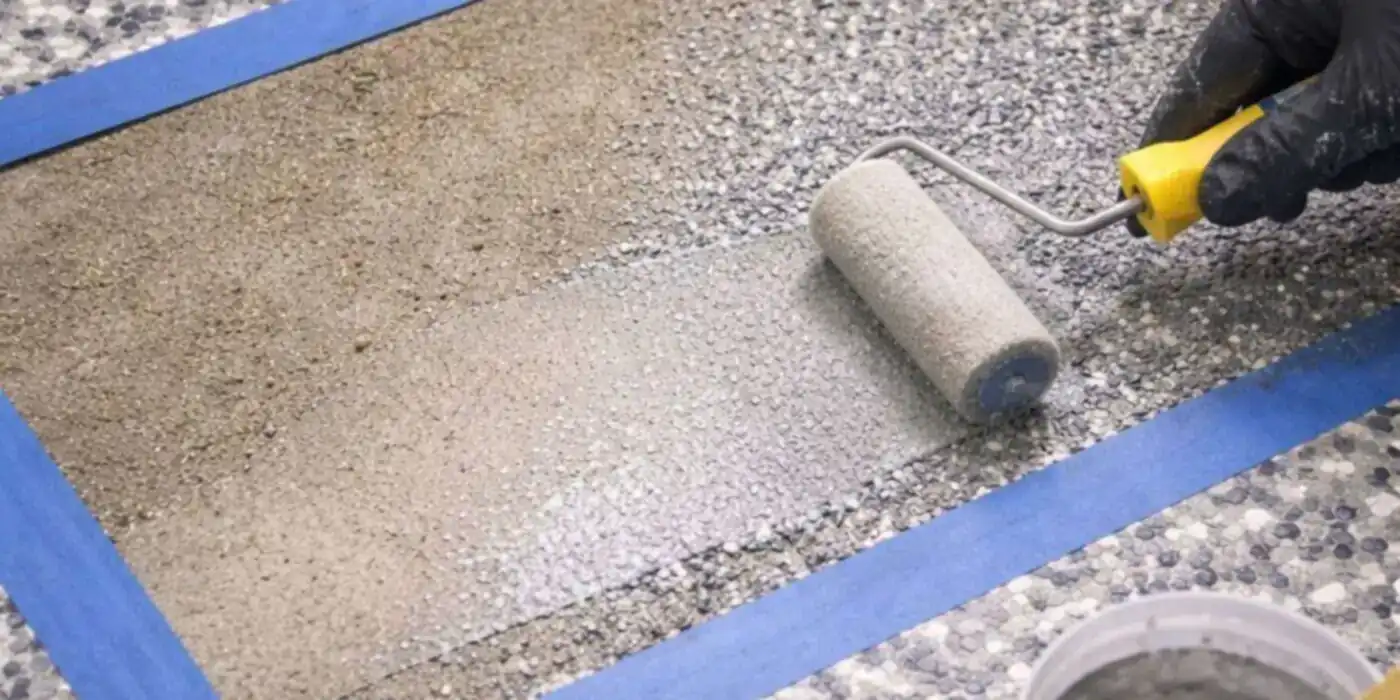
When a coated floor peels, bubbles or cracks in a Houston garage, the resin is usually not to blame. Failures here tend to trace back to one of four things: a slab that moves with the clay beneath it, moisture working up through the concrete, a humid day that should have been a no-go, and prep that got cut to reach a low price. Each one leaves its own signs.
This guide shows how to read them, the checks that catch each problem before coating, and the questions that separate a careful installer from a fast one. It applies to a garage, a room in a slab home or a shop or kitchen, from Kingwood to Sugar Land.
Read the Failure First
How a floor fails usually points to why. Match what you see below.
| What You See | Likely Cause Here | What Prevents It |
|---|---|---|
| Thin lines tracing the slab’s cracks or joints | Clay swelling and shrinking under the slab | Fill only cracks that have stopped moving |
| Blisters and bubbles mid-floor | Moisture rising through the concrete | A moisture reading, then a primer if it’s high |
| Sheets lifting at the edges or the door | Etch-only prep, or dust or curing compound left on | Diamond grinding to clean, open concrete |
| Weak or cloudy patches across one area | Coated while the slab sat near the dew point | Measure slab temperature and dew point on the day |
| A yellow cast near the door | An epoxy top coat in strong Gulf Coast sun | A UV-stable top coat |
| Tire-shaped patches pulled loose | Hot tires on thin or uncured film | Full film thickness; full cure before parking |
Clay Under the Slab
Much of the Houston area is built on clay from the Beaumont Formation. The USDA’s Lake Charles series, with its type location in Fort Bend County, is a shrink-swell clay. Dry, it opens cracks from half an inch to 2 inches across and a foot or more deep. Wet, it swells them shut. Slabs poured on it move with it, a little at a time.
Concrete answers movement by cracking, which is why finishers cut control joints: straight lines meant to crack neatly. The trouble starts when a rigid film goes straight over a crack or joint that is still working. The film has no give, so a thin line soon appears right above the crack.
So the first question is whether the crack is still moving. A stable one can be cleaned out and filled before the coating goes down. An active one is a slab issue, and a good installer says so before quoting, not after the floor splits.
Moisture and the Muggy Morning
Moisture is the cause you can’t see. Concrete is porous, and water vapor in the ground moves up through a slab toward drier air. Trapped under a coating, it gathers at the bond line and pushes the film up as blisters, often months after the job. With rainfall at Bush Intercontinental Airport averaging 51.8 inches annually, it is worth checking on almost any slab here.
The air causes the second problem. Coating makers tell installers not to coat unless the slab surface sits 5°F or more above the dew point. At the airport, summer humidity averages 93 to 94% at 6 a.m., with dew points close to 74°F. A cool, shaded slab at dawn can sit right at the dew point under a film of moisture too thin to see, and a coat applied then starts with a weak bond.
Both are measurable. For the slab, ask whether the installer will use a calcium chloride test or an in-slab humidity probe. For the air, ask them to check slab temperature and dew point on the day and start later if the numbers are close. A slab that has had floodwater on it needs a reading first.
Floor Already Peeling or Bubbling?
Call (713) 360-0167 any time to describe what you’re seeing and get a free quote for the epoxy floor repair.
Heat, Sun and Hot Tires
Heat shortens the working time
Warm resin cures faster, leaving less time to spread each batch. Bush Intercontinental logs about 111 days of 90°F-plus heat in a normal year and roughly 7 at 100°F, and about four months of nights never drop below 70°F. Mix too much at once and it gels in the bucket, then goes down thin.
Sun yellows the wrong top coat
Ordinary epoxy breaks down under UV. In strong Gulf Coast sun it ambers, starting just inside an open garage door. The bond may hold, but the floor looks old. The fix is a UV-stable top coat such as polyaspartic.
Hot tires lift weak film
Tires come home from summer pavement hot. On a thin coating, or one still curing, warm rubber softens the surface, grips it and tears it away. Advertised waits before driving on a new floor range from 12 hours to five days among Houston companies, so ask which applies to your system.
The avoidable cause: cut prep
Behind the climate sits a cause that is purely a choice. Acid etching alone leaves concrete that looks clean but gives the coating little to grip. Coating over a curing compound bonds the floor to the compound, not the slab. Oil, tire marks and dust do the same.
The Prep and Tests That Prevent It
Each failure has a matching step. A floor done properly here usually includes all of them:
- Diamond grinding that removes sealers, oil and curing compound.
- A moisture test before the price is final.
- Cracks sorted into stable and moving, with the moving ones raised with the owner.
- A mitigation primer if the moisture reading comes back high.
- A start time set by the dew point, not the calendar.
- Small batches on hot days.
- A UV-stable top coat anywhere the sun reaches.
- A stated cure time before the first car.
For planning, this is what the key pieces typically cost around Greater Houston. None of it is a quote.
| Item | Typical Houston-Area Price |
|---|---|
| Flake floor with polyaspartic top coat | about $5 – $9 per sq ft |
| 2-car garage, same system | about $2,000 – $4,500 |
| Moisture testing | about $50 – $300 |
| Moisture-mitigation primer | about +$1 – $2 per sq ft |
| Crack patching | about $25 – $250 |
| Resurfacing a badly damaged slab | about $3 – $7 per sq ft |
What to Ask a Contractor
A few questions, and an ear for specific answers, go a long way.
- How will you test for moisture, and what reading changes the plan? A good answer names a method and a number.
- Do you grind or etch? Grinding should be the default.
- How will you tell if my cracks are still moving? Listen for a plan, not “we’ll fill them.”
- Which top coat, and is it UV stable? It should be named.
- What time will you start, and will you check the dew point?
- What’s in writing if it lifts, and when can I park?
Red flags: a quote that never mentions prep, or a full flake floor priced far below the typical $5 to $9 per square foot. See the Houston cost guide and how long an epoxy floor lasts here.
Frequently Asked Questions
Why is my epoxy floor peeling?
Peeling means the coating lost its grip. In Houston the usual reasons are moisture pushing up from the slab, a surface that was etched or swept instead of ground, curing compound left on a new slab, or a coat applied while the slab sat too close to the dew point. Find the cause before recoating, or the new coat fails the same way.
Does Houston's clay really crack coated floors?
Not directly. The clay swells when wet and shrinks when dry, and the slab rides along. Stretch a stiff film across a crack that keeps opening and the film tears right above it. Stable cracks can be filled first; an active crack is a slab issue that no coating fixes.
Can a floor be coated on a humid Houston morning?
Only if the numbers allow it. The surface needs to be at least 5°F warmer than the dew point, and shaded slabs often miss that at dawn, so measure and start later if needed.
Can a failed floor be fixed, or does it need replacing?
Most can be fixed once the cause is known. The failed coating is ground off to sound concrete, cracks and moisture are dealt with, and a new system goes on. Recoating over a peeling floor only delays the same failure.
Why did my new-construction garage floor fail?
Usually one of two reasons: the concrete was coated before it had time to dry, a wait usually given as about 28 days, or a curing compound on the surface was coated over instead of ground off. Both lead to lifting.
Related Articles
Epoxy Floor Maintenance in Houston: Care for Heat, Rain and Hot Tires
Cleaning, top-coat care and the habits that keep a coated floor looking new in Houston heat.
How Long Does an Epoxy Floor Last in Houston?
What a coated floor can last in a Houston garage or shop, and what cuts that short.
Epoxy vs. Polyaspartic Garage Floors in Houston: Heat and Hot Tires
Cost, cure time and sun resistance of the two main coatings, compared for Houston projects.