The short answer: many Greater Houston garages are best served by both coatings at once, with an epoxy base coat and color flakes sealed under a polyaspartic top coat. Pure polyaspartic suits a sun-drenched garage you need back quickly, and plain epoxy still works on floors that never see daylight.
Both are two-part resins that cure into a hard film bonded to concrete. The difference is how each handles what this region has plenty of: heat (Bush Intercontinental Airport averages about 111 days a year at 90°F or hotter), damp air (a 75% mean relative humidity), sun through an open garage door, and slabs that shift on clay. Knowing which layer does which job makes any quote for a garage floor or a patio or slab-level room easier to judge.
Where Epoxy Shines and Struggles
Epoxy is the older chemistry. Resin and hardener are mixed on site and cure into a thick, stiff coating that grips a ground slab hard, levels small dips and pinholes, carries flakes, metallic pigment or quartz, and resists motor oil and most other car fluids. Its weak points in a Houston garage:
- It ambers in sunlight. Standard (aromatic) epoxy yellows under UV, starting with the strip just inside a garage door left open on summer afternoons.
- It dislikes damp air. While it cures, humid air can leave a waxy film called amine blush that weakens the next coat's bond unless it is washed off, and relative humidity at Bush Intercontinental averages 90% at 6 a.m.
- Heat shortens its working time. Mixed epoxy sets faster as the garage warms, and the airport's normal July high is 94.5°F.
What Polyaspartic Brings to a Garage
Polyaspartic is a type of polyurea, and it is aliphatic, so it resists yellowing in sunlight. That makes it the usual clear top coat over a flake floor, and its fast cure is where the one-day garage offers come from.
- Short downtime. Houston sellers of one-day polyaspartic and polyurea systems advertise foot traffic after roughly 2 to 6 hours and parking after about 12 hours to a day.
- Hot-tire resistance. Tires fresh off hot pavement can soften a weak coating and lift it when the car leaves; a fully cured polyaspartic surface resists that. Ads calling one coating many times “stronger” than another rarely cite a test; cure and prep decide how it holds up.
The catch is that same speed. It can set minutes after mixing, so rushed work shows lap marks. It costs more than epoxy, each coat is thin and hides less, and it still needs a clean, dry, ground slab.
Side by Side in Houston Conditions
| Factor | Epoxy | Polyaspartic | Edge in Houston |
|---|---|---|---|
| Sun at the door | Ambers unless a UV-stable top coat covers it | Resists yellowing | Polyaspartic |
| Back in use | Floors with an epoxy base coat: local ads say about 72 hours to day five before parking | One-day polyaspartic systems: parking after about 12 hours to a day | Polyaspartic |
| Hot tires | More prone to pickup, especially if thin | Resists pickup well | Polyaspartic |
| Oil, fluids and cleaners | Resists common garage fluids | Resists common garage fluids | Close; depends on the product |
| Build per coat | Thick; fills small dips and pinholes | Thin; shows a rough slab | Epoxy |
| Working time in heat | Shrinks as the garage warms | Very short in any weather | Neither; both need a skilled hand |
| Damp air | Blush risk on humid mornings | No blush, but damp air speeds its set | Neither; both need the dew-point margin |
| Typical Houston-area price | Solid color: about $3–$6/sq ft | Flake floor with polyaspartic top coat: about $5–$9/sq ft | Epoxy |
Prices are typical Houston-area ranges, not a quote. Return-to-use times are what local installers advertise.
Why the Usual Answer Is Both
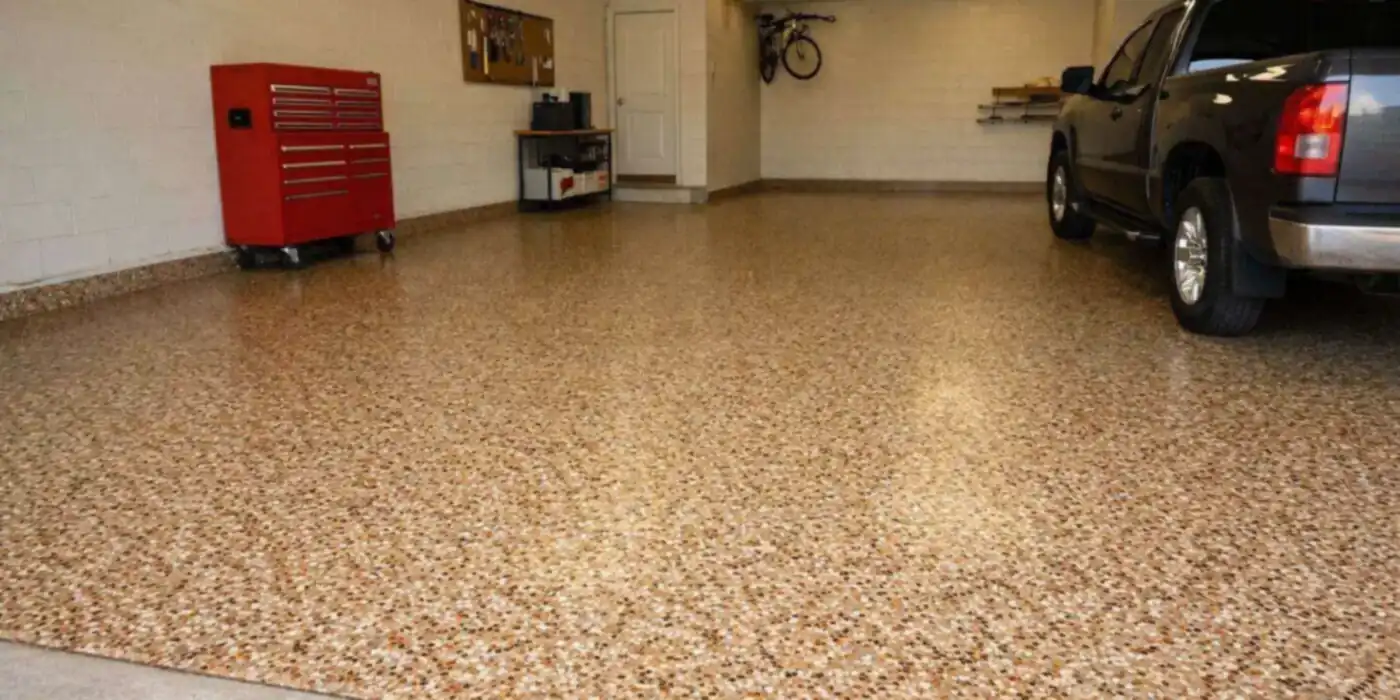
Several Houston installers that publish flake-floor prices pair an epoxy base with a polyaspartic top coat, because each layer does what it is best at.
- Epoxy base coat. On a ground slab it builds thickness and carries the bond. Some systems start with a moisture-mitigating epoxy primer.
- Broadcast flakes. Vinyl flakes, or quartz in a work area, add color and texture and hide small chips.
- Polyaspartic top coat. It takes the sun, the hot tires and the scuffing.
Built this way, a flake floor typically runs about $5 to $9 per square foot in the Houston area, or about $2,000 to $4,500 for most 2-car garages. Slab size, cracks and moisture work move the number. These are planning figures, not a quote.
Planning a Flake Floor for Your Garage?
Try colors and flake blends in Floor Studio, then call (713) 360-0167 any time for a free, no-obligation quote.
Get a Free QuoteThe Slab Matters More Than the Resin
A top coat is only as sound as the concrete under it, and three local conditions matter more than the brand on the bucket.
Clay that moves. Much of the area sits on Beaumont Formation clay, mapped as the Lake Charles soil series. It cracks up to 2 inches wide as it dries, with cracks open 60 to 90 days in most years, and swells again when wet. No coating stops a slab from moving; a live crack comes back through either resin.
Water. With about 52 inches of rain a year at Bush Intercontinental, plenty of garages get wet, and a damp slab can push any coating off from below.
Install-day air. Coating makers advise applying only when the slab is at least 5°F above the dew point, and summer dew points at the airport average about 74°F.
So ask any installer about:
- A moisture reading. It typically costs about $50 to $300; if readings are high, a moisture-mitigation primer adds about $1 to $2 per square foot.
- Diamond grinding rather than acid etching alone.
- Crack treatment, including which cracks may return. Patching usually runs about $25 to $250.
- A dew-point check before the first coat goes down.
Store-Bought Kits in a Humid Garage
Most retail kits go on thinner than installer systems and lean on acid etching instead of grinding. Many leave out a UV-stable top coat, and thin films are the ones most prone to hot-tire pickup. Nothing in the box measures slab moisture or the dew point, which is what decides a humid Houston morning. A failed kit usually has to be ground off before a professional system can bond.
Picking a System for Your Space
A full polyaspartic floor may suit you if:
- The garage door faces afternoon sun and stays open a lot
- You need the garage back fast, for a move or a sale
- You will pay a premium for the quickest return to use
An epoxy base with a polyaspartic top coat may suit you if:
- You want a flake or metallic look that resists yellowing
- You want the system several Houston installers price as their standard flake floor, at about $5 to $9 per square foot
- You are coating a workshop or a shop or showroom
Solid-color epoxy may suit you if:
- The room gets little or no direct sun
- Budget comes first, at about $3 to $6 per square foot
- You want a plain, hard-wearing floor that is easy to stripe, as in warehouses and service bays
Frequently Asked Questions
Is polyaspartic better than epoxy for a Houston garage?
As a top coat, usually yes: it resists yellowing in sunlight, cures fast and resists hot-tire pickup. Epoxy remains the better base coat because it builds thickness and grips a ground slab well, which is why a common choice here is an epoxy base under a polyaspartic top coat.
Why does epoxy turn yellow in a garage?
Standard epoxy is aromatic, and ultraviolet light slowly changes its color. The floor by the garage door gets the most sun, and Bush Intercontinental records about 70% of possible sunshine in July. A clear polyaspartic or other aliphatic top coat guards against the color shift.
How much does a polyaspartic garage floor cost in Houston?
A flake floor with a polyaspartic top coat typically runs about $5 to $9 per square foot in the Houston area: about $1,000 to $2,700 for a 1-car garage, $2,000 to $4,500 for a 2-car and $3,000 to $7,000 for a 3-car. These are typical area prices, not a quote.
Can a garage be coated on a humid Houston morning?
Only when conditions check out. Coating makers advise applying when the slab is at least 5°F warmer than the dew point, and Houston mornings are often too damp for that. A careful installer measures first and shifts the start time if needed.
Will a polyaspartic floor stop my slab from cracking?
No. Neither coating stops a slab from moving. Houston's clay swells when wet and cracks as it dries, and a crack that is still moving can come back through any coating. Each crack should be checked for movement before coating, and you should be told which ones may return.
What are the downsides of polyaspartic?
It costs more than epoxy, sets so fast that it leaves little room for mistakes, and goes on thin, so it will not hide a rough slab. It can be slick when wet unless texture is added, and it still fails over a damp or poorly prepared slab. Using it as the top coat over an epoxy base manages most of these.