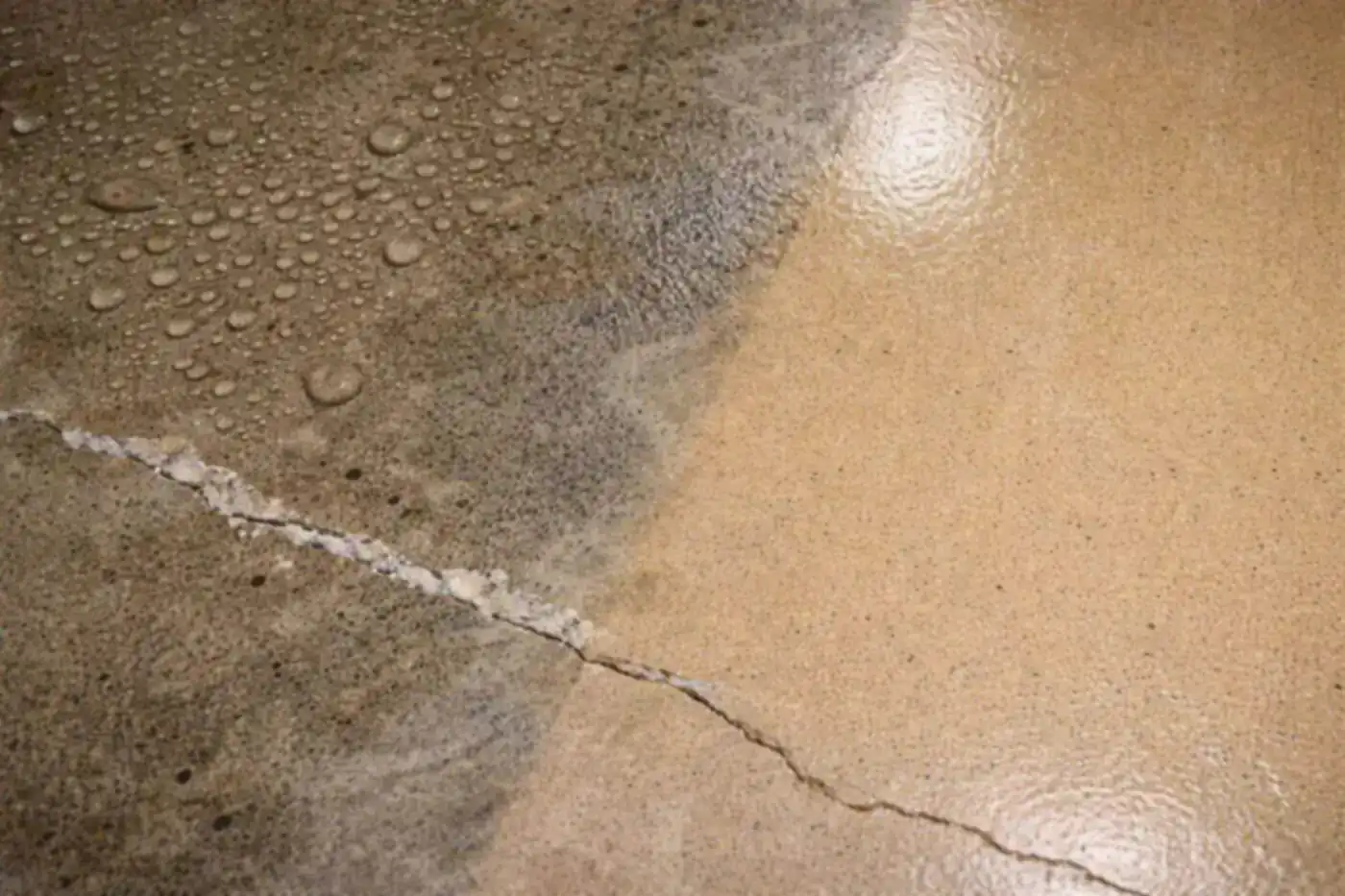
A coated garage floor in Greater Houston can look sharp for well over a decade, or start lifting at the door before its second summer. The resin in the can rarely decides which. The slab underneath, the weather on the day of the job and the top coat do. Below are the commonly quoted ranges and the Houston conditions that stretch or shorten them. They are rules of thumb, not a promise from anyone.
The Rough Numbers
For a two-car home garage with ordinary use, a professionally applied system is commonly quoted at 10 to 20 years, with the better flake floors near the top after one fresh top coat. Thin retail kits often show wear within one to three years.
Commercial floors count years differently. Pallet jacks, hot washdowns and dropped weights wear a floor far faster than two cars, so busy commercial floors are usually quoted at roughly 5 to 10 years, with the traffic lanes wearing first. That is normal wear, not a defect.
Lifespan by System
The table assumes the slab was ground, cracks were handled and moisture checked. Skip that prep and every system wears out sooner.
| System | Home Garage | Busy Commercial Floor | What Decides It |
|---|---|---|---|
| Retail DIY kit | Often 1 – 3 years | Not built for it | Thin film, little or no grinding |
| Solid-color epoxy | Lower end of the 10 – 20 year range | Traffic lanes wear first | Whether the top coat is UV stable |
| Flake + polyaspartic top coat | Upper end of the range | Top coat renewed more often | Renewing the top coat before the chips wear through |
| Metallic epoxy | Middle of the range | Scratches show quickly | The clear coat, where scratches show first |
| Quartz broadcast | Upper end of the range | Common in wet, busy areas | A thick, textured build |
| Urethane cement | Rarely used at home | Chosen for kitchens and washdown | Built for hot water and food acids |
The longest-lived systems carry a tough wear layer that can be renewed without starting over. That is why so many Houston garage installers lead with flake and a polyaspartic top coat. For the trade-offs between top coats, see epoxy vs. polyaspartic in Houston.
What Shortens a Floor’s Life in Houston
Ask how the job will handle each of these.
Clay That Swells and Shrinks
Much of Greater Houston sits on Beaumont Formation clay. One of the main soils on it, the USDA’s Lake Charles series, cracks up to 2 inches wide as it dries, and those cracks stay open 60 to 90 days in most years. Slabs shift a little as the ground shrinks and swells. A rigid coating over a crack that is still moving will split along the same line, and no coating stops a slab from moving. Check whether a crack is active before anything goes over it.
Humid Mornings
Bush Intercontinental Airport averages about 90% relative humidity at 6 a.m., and summer dew points sit near 74°F. Coating makers say to coat only when the surface is at least 5°F above the dew point. A shaded slab at a July dawn can miss that, and a coat laid on damp concrete may lift months later.
Heat and Sun at the Door
The airport averages about 111 days a year at 90°F or hotter and around 70% of possible sunshine in July. Standard epoxy isn’t UV stable, so the strip of floor the sun reaches through an open door ambers first. A UV-stable top coat, usually polyaspartic, holds its color.
Parking Too Soon
Houston installers advertise anywhere from about half a day to five days before you drive on a new floor. Hot tires on a film that hasn’t finished curing can pull patches loose for good. Get the parking time in writing and wait it out.
Water From Above and Below
Bush Intercontinental averages close to 52 inches of rain a year, and some of it ends up in garages. A coated floor cleans up after it far more easily than bare concrete. It is not waterproofing, though, and a coat laid over a slab that is damp from below can blister.
Skipped Prep and Green Concrete
Acid etching alone, or a quick sweep, leaves too shallow a surface for the coating to bite into, so it sits on the slab instead of bonding. New slabs often carry a curing compound that must be ground off, and fresh concrete needs time to dry, commonly about 28 days. That matters where building is recent: in the Cypress ZIP code 77433, Census estimates put 87% of homes at 2000 or newer.
Planning a Floor That Lasts?
Call (713) 360-0167 any time to talk through your slab, the system that suits it, and a free quote.
What Helps a Floor Last
Most of what adds years happens before the first coat goes down. The rest is simple care.
- A ground surface. Diamond grinding, not acid etching alone.
- Cracks checked, then filled. A crack that is still moving gets raised before anyone coats over it. Typical patching runs about $25 to $250.
- A moisture reading. Typically about $50 to $300. When readings are high, a moisture-mitigation primer adds roughly $1 to $2 per square foot.
- The right hour. Slab at least 5°F above the dew point, measured on the day.
- A UV-stable top coat, especially on the first few feet inside the door.
- A fresh top coat before wear-through.
- A weekly sweep. Grit carried in on tires works like sandpaper.
These are typical Houston-area prices, not a quote. The Houston cost guide has the full breakdown.
Homes vs. Businesses
Homes
Greater Houston is slab country, and the garage slab is the usual starting point. In Fort Bend and Montgomery counties the median home dates from 2006, so a lot of garage slabs there are under twenty years old. Pasadena’s median home dates from 1977 and Galveston’s from 1973, and older slabs like those are more likely to need crack or surface repair first. More on garage floors and residential floors.
Businesses
Commercial kitchens and washdown areas often get urethane cement or quartz, and a busy shop needs a heavier build than a home garage. In food businesses the floor is a code matter too: Texas adopts the FDA Food Code, which calls for floors that are smooth, durable, easily cleanable and nonabsorbent where things get wet. The Houston Health Department permits food businesses inside the city, and Harris County Public Health covers unincorporated Harris County and cities such as Humble. See commercial floors.
Signs Your Floor Is Wearing Out
Caught early, most wear needs a new top coat, not a full redo.
- Dull, chalky gloss. The top layer is thinning.
- An amber tint near the door. A top coat that isn’t UV stable is breaking down.
- Fine lines over joints or old cracks. The slab is moving underneath.
- Lifting edges or bubbles. Usually a bond or moisture problem.
- Bare patches where the tires sit. A weak bond losing out to hot tires.
Dullness calls for a scuff-sand and a new top coat. Peeling or bubbling means the old coating comes off and the slab is prepped again. See why epoxy floors fail in Houston for the causes and repair and maintenance for the fixes.
Frequently Asked Questions
How long does an epoxy garage floor last in Houston?
As a rough guide, a professionally applied system is commonly quoted at 10 to 20 years in a home garage, with flake and a polyaspartic top coat toward the top of that range and solid-color epoxy lower. Retail kits commonly show wear within one to three years. Prep, the weather on the day and the top coat decide where a floor lands.
Does the Houston heat shorten its life?
Heat alone doesn't ruin a well-chosen system, but it adds stress. The sun through an open door yellows any top coat that isn't UV stable, and hot tires pull at weak spots. A UV-stable top coat and a full cure before parking handle most of it.
How often should the top coat be renewed?
There is no fixed schedule. Recoat once the gloss dulls in the tire paths, before the chips wear through; busy commercial floors get there sooner. Doing it while the chips are still covered costs far less than stripping the floor.
Will water in the garage shorten its life?
Water on a sound, well-bonded coating mostly means cleanup, and a coated floor is much easier to clean than bare concrete. A coating is not waterproofing, though. If the slab has had water on it, get a moisture reading before any new coat goes down.
Can a worn floor be recoated instead of replaced?
Often, yes. A coating that is still firmly bonded can be scuff-sanded and given a new top coat. One that is peeling or blistering has to come off first. Call (713) 360-0167 any time to talk it through and get a free quote.
Related Articles
What Does Epoxy Flooring Cost in Houston? Typical 2026 Prices
Typical Houston-area prices by system and garage size, and what moves them.
Epoxy vs. Polyaspartic Garage Floors in Houston: Heat and Hot Tires
How the two top coats compare on cure time, sun and hot tires in a Houston garage.
Flake, Metallic, Solid or Quartz: Choosing an Epoxy Floor in Houston
Flake, metallic, solid color and quartz side by side, and where each one fits.