Industrial Epoxy Flooring in Houston for Warehouses, Plants & Shops
Heavy-duty resin floors for Houston warehouses, plants and bays, built for forklifts, washdowns and humid air.
Industrial Floors for a Port, Petrochemical & Logistics Region
Greater Houston runs on industry. Port Houston ranks first among U.S. ports for foreign waterborne tonnage, the Ship Channel is lined with more than 200 private terminals, and one broker's mid-2026 report counted about 23 million square feet of industrial space under construction around Houston. That is why the region has so many slabs that need industrial epoxy: fabrication and machine shops, parts distributors, food and beverage plants, cold storage and flex warehouses.
An industrial floor is matched to the room, not pulled off a shelf:
- Urethane cement for food and beverage rooms and floors that take hot-water washdowns
- High-build, 100%-solids epoxy for warehouse aisles, racking and staging areas
- Novolac epoxy where concentrated acids or solvents can pool
- Quartz broadcast with an anti-slip top coat for wet processing areas
- Static-control (ESD) coatings for electronics benches and instrument rooms
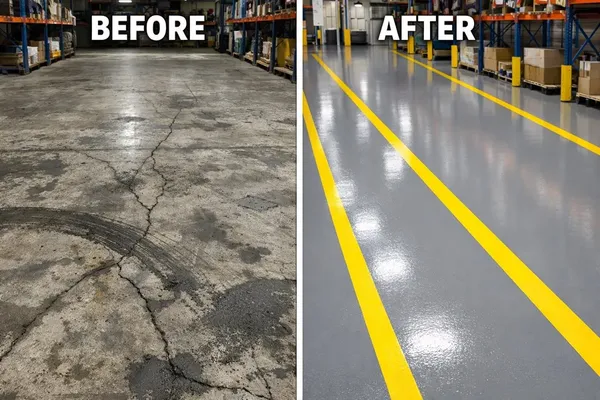
- Color-coded aisles, walkways and hazard zones striped into the top coat
Under the concrete, the story is clay. Houston-area soils formed on the Beaumont Formation, and the Lake Charles series, whose type location is in Fort Bend County, cracks up to 2 inches wide at the surface in dry spells and swells again when rain returns. Across a big warehouse slab, that movement can show up as cracks and joints that keep working. Before any coating goes down, those get mapped and sorted: stable cracks filled, moving joints kept as joints with a flexible filler. A coating will not stop a slab from moving, and it should never be sold as if it could.
Air is the second variable. The Bush Intercontinental weather station averages 75% relative humidity, summer dew points sit near 74°F, and a building with its dock doors open can swing through the day. Resin makers want the surface 5°F or more above the dew point before coating, so a careful installer logs slab temperature and dew point zone by zone and moisture-tests the slab before choosing a primer.
Fitting out a customer-facing room instead, such as a restaurant, showroom or office? Start with commercial epoxy flooring.
Industrial quotes cover 10 places across Greater Houston: Pasadena and Baytown on the Ship Channel side, Cypress, Spring, Humble and Kingwood across the north, Sugar Land and Missouri City to the southwest, plus Galveston and Houston itself.
What an Industrial Floor in Houston Has to Handle
Forklifts, washdowns, chemicals, humid air and a slab that moves with the clay. The system should be chosen for all of them at once.
Novolac
Chemical & Acid Resistant
Standard epoxy handles oil, grease and most shop fluids. Where concentrated acids or strong solvents can pool, as in battery rooms or chemical storage, novolac epoxy is the usual step up. Ask which chemicals the top coat is rated for, by name.
Forklifts
Built for Wheel Traffic
Hard wheels turning in the same spot, pallet jacks and racking feet put heavy load on a few square inches. High-build epoxy or urethane cement at the right thickness takes that abrasion far better than a thin, paint-grade coat.
Anti-slip
Traction Where Floors Get Wet
Washdown zones, cooler thresholds and hosed-out bays are where people slip. Broadcast quartz or anti-slip aggregate keeps footing; more texture means more grip but harder cleaning, so the level is a trade-off.
Striping
Safety Line Marking
Forklift lanes, pedestrian walkways, staging grids, dock edges and hazard areas can be striped into the system in color, so the layout lasts instead of peeling like floor tape.
ESD
Anti-Static Options
Electronics benches, instrument rooms and some storage areas need a floor that drains static away. Conductive and dissipative coatings exist for that job; the right one depends on the equipment and the spec your facility follows.
Thermal
Heat & Hot Washdown
Long summers (Bush Intercontinental averages roughly 111 days of 90°F-plus heat each year) and hot-water or steam cleaning both put thermal stress on a floor. Urethane cement copes with thermal shock better than standard epoxy, which is why it shows up in food plants.
How epoxy and polyaspartic compare in Houston →What a Proper Industrial Install Involves
Large floors are won or lost in the prep. These are the steps a good industrial job follows; bigger buildings are usually done in phases so part of the operation keeps moving.
Facility Survey
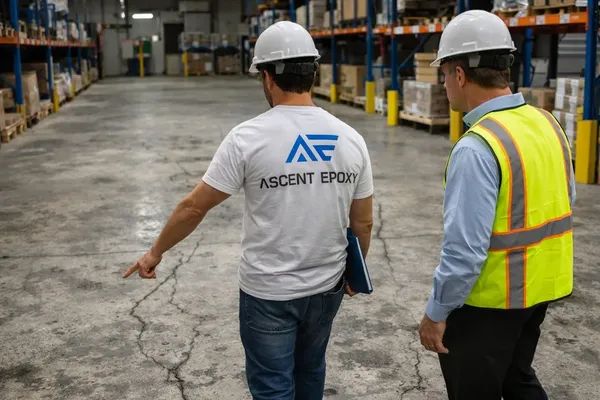
Walk-throughThe whole floor gets walked and mapped: moisture readings in several zones, cracks and joints logged, chemicals on site listed, and forklift routes and racking marked. Get a free quote to start.
Grinding or Shot Blasting
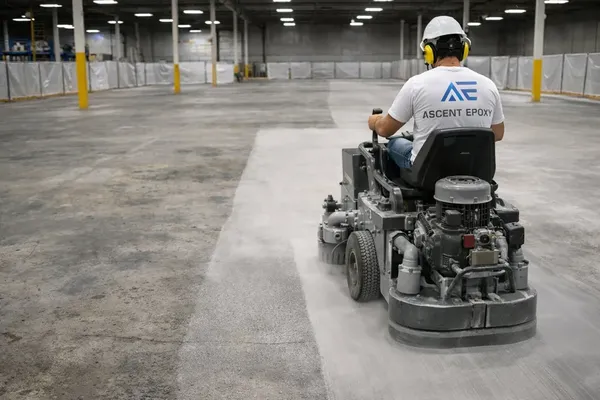
PrepDiamond grinding or shot blasting opens the whole surface to a clean profile. Moving joints are handled first with fillers that can flex, so the new coating is not bridged rigidly across a joint that still moves.
Primer & Moisture Barrier
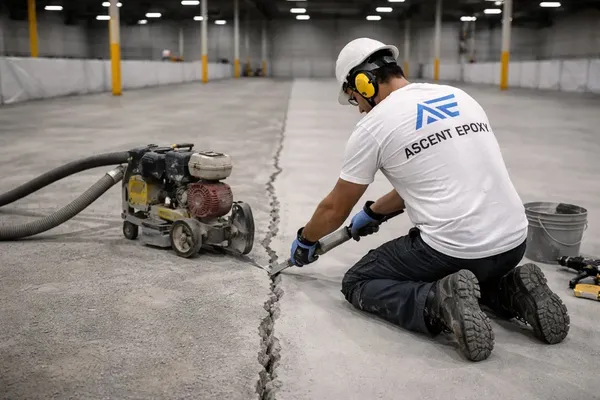
PrimerA penetrating primer locks the system to the concrete. Where readings run high, a moisture-mitigating primer goes down instead, typically adding about $1–$2 per sq ft. In humid heat the installer watches surface temperature and dew point so the primer cures properly.
Build Coats & Striping
SystemBody coats go down at the thickness the traffic calls for, with chemical-resistant, impact-rated or static-control formulas where the room needs them. Quartz or anti-slip aggregate, lane striping and zone colors are added at this stage.
Cure Check & Handover
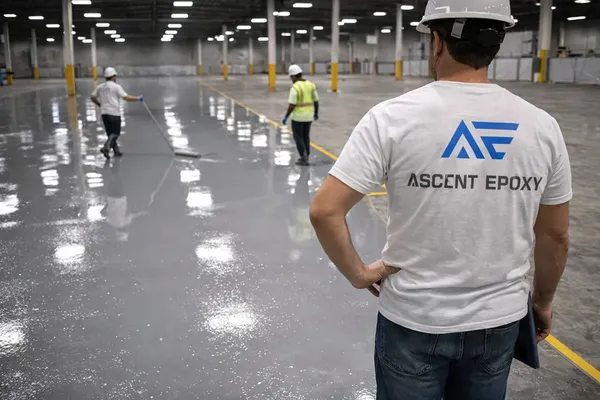
HandoverHardness and adhesion should be checked before forklifts come back. Cure times depend on the product, the temperature and the humidity, so get them in writing, along with cleaning instructions for your system.
Planning a Warehouse or Plant Floor?
Send the square footage, what drives on it and what spills on it. Call any time or use the form below for a free quote.
Industrial Floor Examples
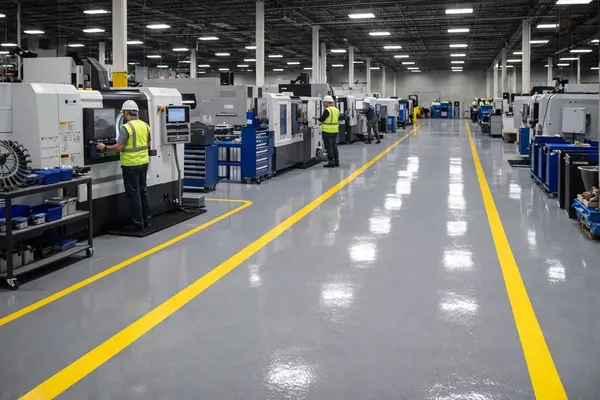
Heavy-duty finishes of the kind used in warehouses, plants and maintenance bays.
Reviewed on Google, Including a Heights Warehouse
Customer reviews from our Google Business Profile, quoted word for word.
"I can't thank this company enough for their exceptional service. My industrial warehouse in the Heights neighborhood now has a stunning new epoxy floor that has completely transformed the space."
"I am really impressed with the attention to detail and professionalism of this epoxy flooring installation service. Thank you so much!"
"I had been searching for a reliable epoxy flooring installation service for months, and I finally found the perfect team."
Industrial Floor Questions From Houston Facilities
What plant managers and warehouse owners ask most.
Warehouses and distribution centers, manufacturing and fabrication shops, food and beverage processing rooms, cold storage, fleet and maintenance bays, and electronics or control rooms.
Each needs a different build, from impact resistance on a busy warehouse floor to washdown and thermal-shock resistance in a food plant.
Typical figures by system: grind and seal starting around $3.50 per sq ft, high-build epoxy about $5–$8, and urethane cement about $8–$15. A 10,000 sq ft high-build warehouse floor typically lands around $50,000–$80,000.
Those are area and industry figures for budgeting, not a quote from us. Our Houston pricing guide has more.
It decides a lot, so moisture belongs in the plan from day one. The slab should be moisture-tested in several zones before coating (testing typically runs about $50–$300); high readings call for a moisture-mitigating primer, usually about $1–$2 more per sq ft.
Each coat should go down only when the surface is at least 5°F above the dew point, which on a humid morning can mean waiting.
Yes, within limits set by the chemistry. Standard epoxy resists oil, grease, fuels and mild cleaners. Novolac epoxy is the usual choice where concentrated acids or strong solvents sit on the floor, and urethane cement handles hot water, thermal shock and food acids well.
List the chemicals your facility actually uses and ask for product data showing each one.
Yes. Forklift lanes, pedestrian walkways, hazard and restricted areas, equipment boundaries, exit paths and color-coded zones can all be striped in as part of the system, where they hold up to traffic longer than tape or ordinary floor paint.
It depends on square footage, slab condition, the system and the weather, so no single answer fits every building. Large floors are usually phased so part of the operation keeps running.
Before work starts, ask for a written schedule that shows each zone, the cure time before foot traffic and the cure time before forklifts.
Try industrial floor finishes before you call.
Pick a size, finish and color, see a sample render, and compare it with typical Houston-area prices.
Open Floor Studio →