Commercial Epoxy Flooring in Houston for Kitchens, Gyms, Shops & Bays
Seamless floors for Greater Houston restaurants, gyms, shops, clinics and service bays, with typical prices up front.
Where Commercial Epoxy Earns Its Keep in Greater Houston
The Ship Channel, the Texas Medical Center and the Energy Corridor on I-10 get the headlines. Around them sits a whole tier of everyday businesses whose floors take a beating, and those are the floors commercial epoxy flooring is for.
Rooms where a coated floor pays off quickly:
- Restaurant kitchens, dish pits, bars and walk-in coolers
- Gyms, fitness centers and studios
- Retail sales floors and showrooms
- Vet, dental and medical offices
- Auto service bays, tire shops and detailing shops
- Flex space and small shops off Beltway 8, US 290, I-45 and the Grand Parkway
The appeal is the surface itself. A resin system bonds to the concrete and cures into one continuous layer, with no grout lines or tile seams for grease, mop water and grit to settle into. That matters most in kitchens: the Food Code that Texas adopts wants food-area floors smooth, durable and easily cleanable, and nonabsorbent where they get wet, and a new restaurant inside Houston city limits files a room-finish schedule with the Houston Health Department. If forklifts or pallet jacks run on the floor, industrial epoxy flooring is the heavier build, and our commercial floor coating guide matches systems to each kind of business.
Two local conditions shape the prep: Beaumont Formation clay that swells when wet and cracks as it dries, which puts slab cracks on the checklist, and humid air that often decides when coating can start. For how top coats compare in this climate, read epoxy vs. polyaspartic in Houston.
Typical commercial prices by system — not a quote:
- Grind and seal: from about $3.50 per sq ft
- Epoxy: about $3–$5 per sq ft for a standard two-coat system, about $5–$8 for high-build 100% solids
- Polyaspartic or polyurea systems: about $5–$12 per sq ft
- Flake broadcast: about $5–$9 per sq ft; quartz from about $10 per sq ft in Houston
- Metallic epoxy: about $6–$12 per sq ft
- Urethane cement for kitchens and washdown floors: about $8–$15 per sq ft
- Cove base: about $12–$14 per linear foot
Overall, commercial floors typically run about $4–$12 per sq ft. These are typical commercial ranges, not a quote from us; cracks, moisture and phasing move every number. Our Houston pricing guide goes deeper.
We quote commercial floors in 10 places across Greater Houston: Houston itself, Sugar Land, Cypress, Spring, Humble, Kingwood, Missouri City, Pasadena, Baytown and Galveston.
What a Coated Floor Does for a Houston Business
Six practical reasons businesses trade tile, VCT or bare concrete for a resin floor.
Phased
Work Around Your Hours
Many commercial floors can be coated in sections, so one zone cures while the rest of the business stays open. Ask for the phasing plan and cure times in writing.
Food Code
Kitchen-Friendly Surface
No grout joints to scrub and nothing porous to soak up grease. A seamless floor with a cove base suits the smooth, cleanable, nonabsorbent standard kitchens are inspected against.
Wipe-clean
Chemical & Stain Resistant
Fryer oil, motor oil, sanitizers and spilled drinks wipe up instead of soaking in. For harsher chemicals, pick the resin and top coat for that exposure, not a garage-floor spec.
Grip
Slip-Resistant Options
Anti-slip aggregate or a textured top coat adds traction on kitchen lines, in dish pits and at entries. With 51.8 inches of rain a year at Bush Intercontinental, the front door matters as much as the kitchen.
UV-stable
Ready for Long Hot Seasons
Bush Intercontinental averages about 111 days a year at 90°F or hotter. Storefronts and roll-up doors that catch strong Gulf Coast sun need a UV-stable top coat; plain epoxy tends to amber in sunlight.
Epoxy vs. polyaspartic in Houston →Mop
Easy Daily Maintenance
No wax, no stripping, no grout lines to scrub. A dust mop and a neutral cleaner handle most days, a real help when a small staff closes up at night.
See full pricing guide →How a Commercial Floor Gets Done Right
What a properly done commercial floor involves, from first look to handover.
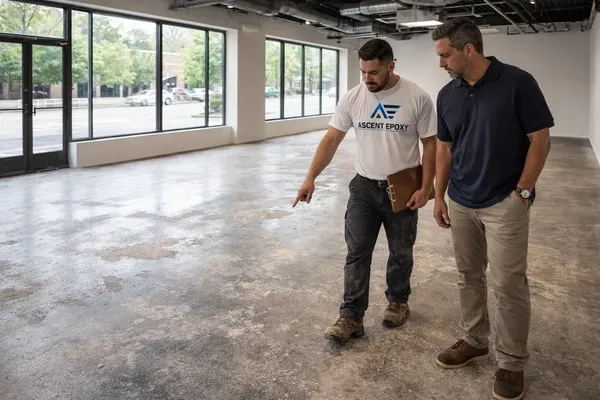
Slab Assessment
Look firstA good installer looks at the concrete in person before pricing it: old coatings, cracks, control joints, soaked-in oil and moisture. The room gets measured and the spills, traffic and hours you need to protect noted. Start with a free quote.
System & Phasing Plan
PlanThe use decides the build: a kitchen, a gym and a showroom each need a different primer, body coat, texture and top coat. Larger floors get a written phasing plan showing which zone is coated when.
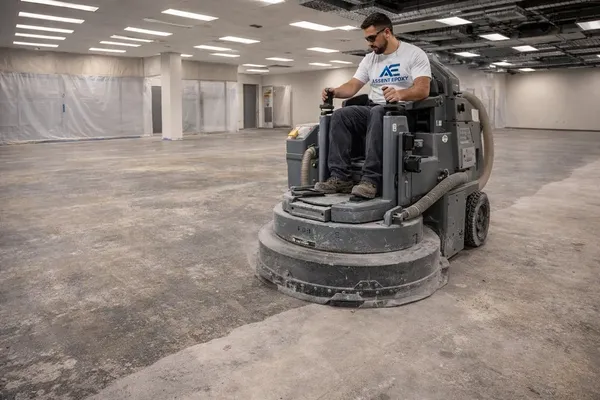
Grinding & Repairs
PrepThe surface is diamond-ground, not just acid-etched, so the primer grips open concrete. Stable cracks are filled, moving joints stay joints, and high moisture readings mean a moisture-mitigating primer goes down first.
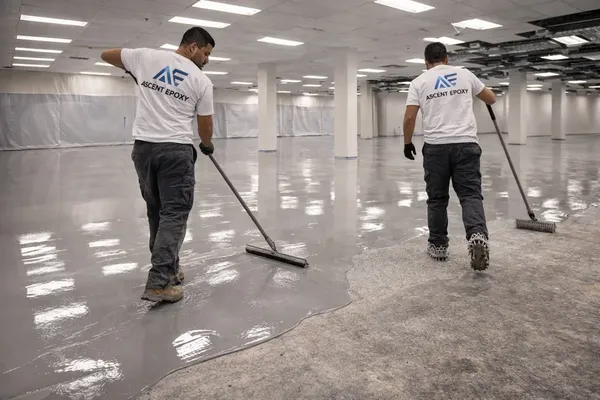
Coats & Texture
CoatPrimer, body coat, any flake, quartz or metallic broadcast, then a UV-stable top coat, with anti-slip aggregate where the floor gets wet. On humid days each coat waits for slab temperature and dew point to line up.
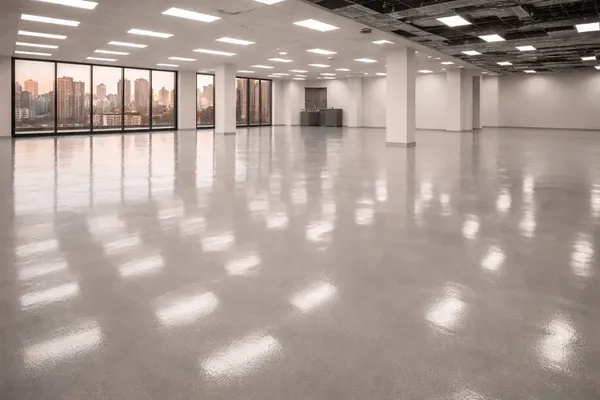
Cure & Care
HandoverThe floor is checked before it goes back into service, with cleaning instructions for your kind of business. Ask how long before foot traffic, carts and equipment; cure times vary with the product and the weather.
Start With a Free Quote
Tell us what the room is for and roughly how big it is. Call any time or use the form below.
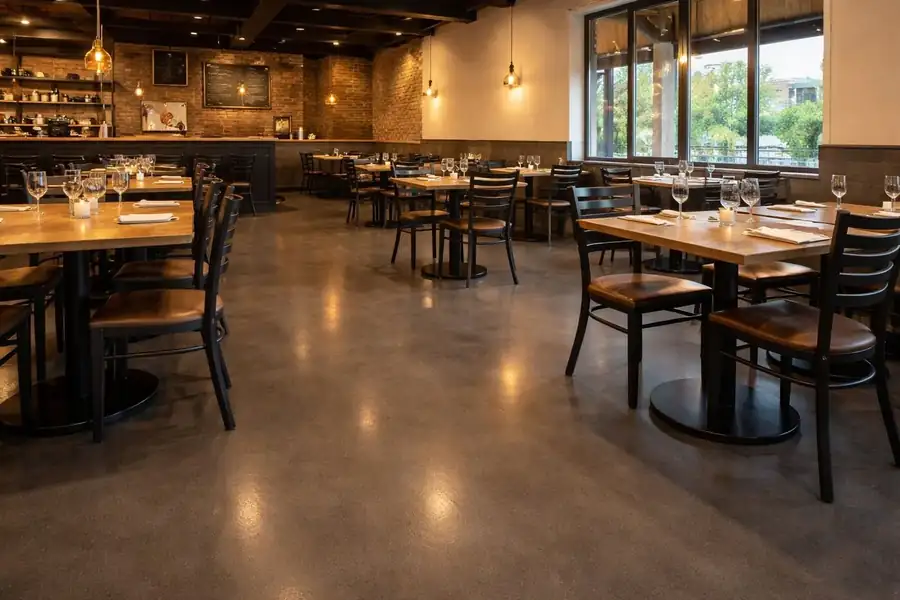
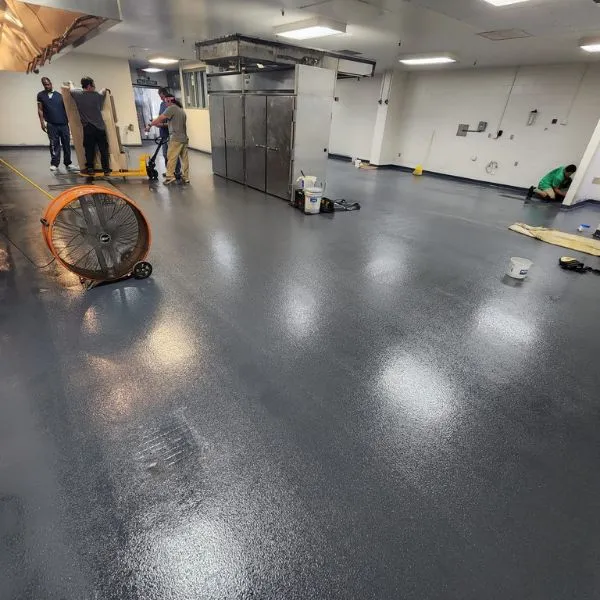
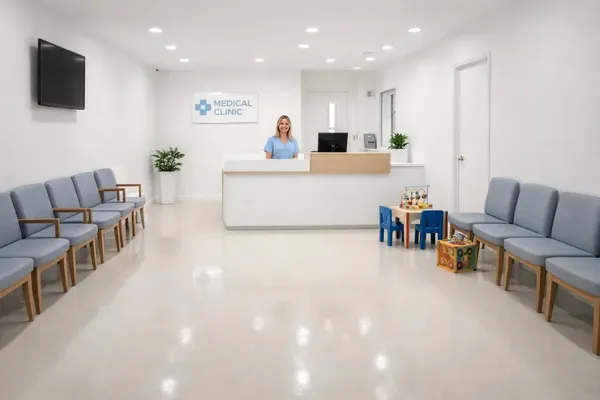
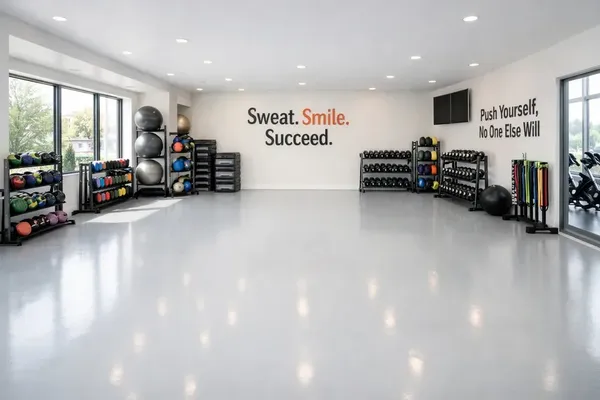
Commercial Floor Finishes
Examples of restaurant, office and service-bay floors.
What Reviewers Wrote on Google
From our Google Business Profile, quoted exactly as posted.
"They installed a new floor in my restaurant, and it looks absolutely stunning. They worked around our schedule, and the end result is beyond my expectations."
"I am so impressed with the quality of work that this company provides. They recently installed a new epoxy floor in my fitness center in Sugar Land, and it looks amazing."
"The service is always on point and the products are superior quality. I highly recommend them to anyone in need of epoxy services."
Commercial Floor Questions From Houston Business Owners
Straight answers for Greater Houston business owners.
It depends mostly on the system. Typical planning ranges: grind and seal from about $3.50 per sq ft, polyaspartic about $5–$12 and kitchen urethane cement about $8–$15.
Treat those as planning numbers, not a quote from us; our Houston epoxy pricing guide has more detail.
Often, yes. Larger floors are usually coated in sections, and restaurants and shops often after hours or over a weekend.
How long each zone stays out of service depends on the product, the temperature and humidity, and what has to roll across it, so ask for the phasing plan and cure times in writing.
It can be. Texas adopts the FDA Food Code, which asks for food-area floors that are smooth, durable and easily cleanable, and nonabsorbent in wet areas such as prep rooms, walk-in refrigerators, dish areas and restrooms. A seamless resin floor with a cove base is chosen for exactly those qualities, and urethane cement is common where floors see hot water and daily washdown.
Inside Houston city limits the Houston Health Department issues food permits; in unincorporated Harris County and cities such as Humble, Harris County Public Health does. Confirm the floor finish with your inspector before choosing a system.
Yes. Relative humidity at Bush Intercontinental averages 75% over the year and about 90% at 6 a.m., with summer dew points near 74°F. Coating makers say to coat only when the surface is at least 5°F above the dew point, so a good installer measures both before each coat.
The slab should also be moisture-tested first (typically about $50–$300), and a moisture-mitigation primer adds about $1–$2 per sq ft when readings call for it.
No. Greater Houston sits on clay that swells and shrinks with the seasons, and a crack that is still moving can come back through any coating. A good installer checks each crack, patches the stable ones (typically about $25–$250) and keeps working joints as joints.
If a crack points to foundation movement, you should hear that before anyone coats over it.
Ten places across Greater Houston: Houston, Sugar Land, Cypress, Spring, Humble, Kingwood, Missouri City, Pasadena, Baytown and Galveston. Kingwood is part of the City of Houston, and Galveston is an island city in Galveston County.
Try commercial floor colors before you call.
Pick a size, finish and color, see a sample render, and compare it with typical Houston-area prices.
Open Floor Studio →