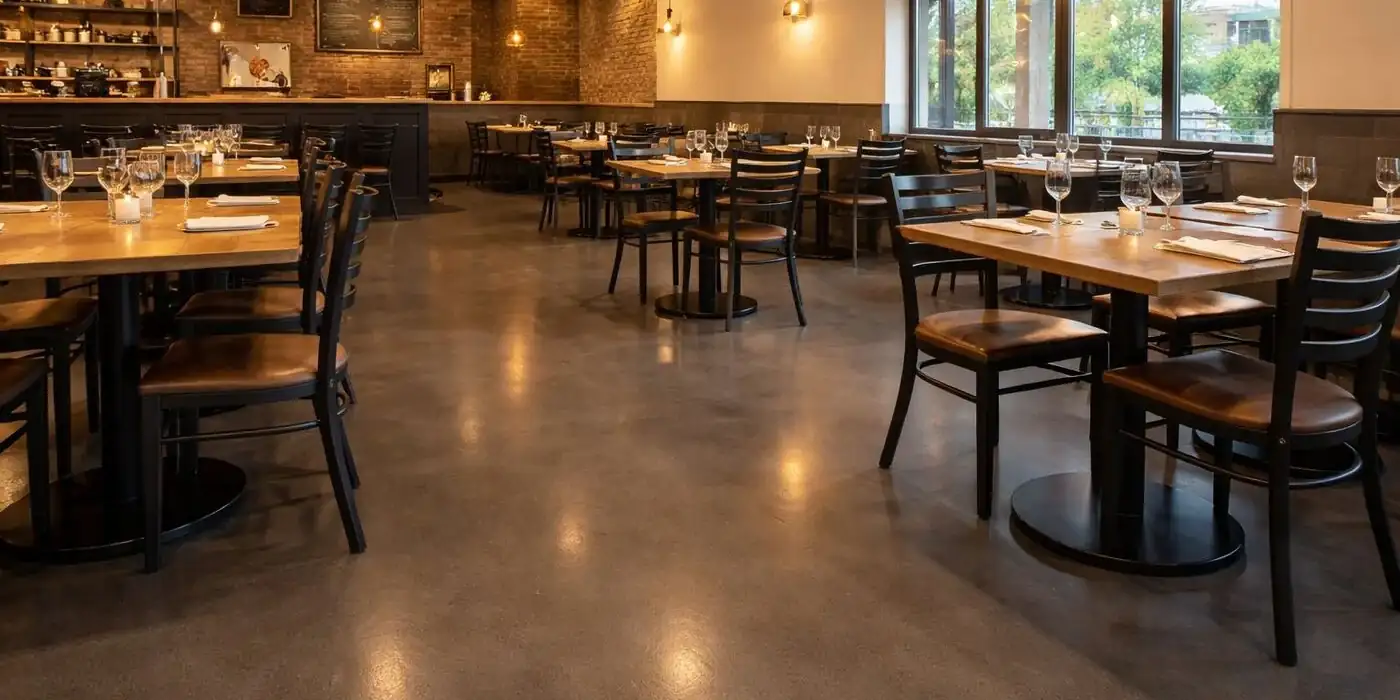
The short answer: a commercial epoxy floor turns bare, dusty concrete into one seamless surface that cleans fast, takes carts and forklifts, and can be textured where it gets wet. Commercial floors typically run about $4 to $12 per square foot, up to about $15 for kitchen urethane cement. Treat those numbers as a planning guide, not a quote.
Houston's economic anchors, from the Ship Channel to the Texas Medical Center and the Energy Corridor, support a deep bench of smaller businesses: warehouses, kitchens, repair shops, clinics and gyms, in flex buildings off Beltway 8 and storefronts along the Grand Parkway.
What a Coated Floor Does
Few owners buy a floor for looks alone. What they get:
- No seams. Grease, spilled product and water have no grout lines to settle in.
- Fast, thorough cleaning. A sealed floor can be scrubbed and sanitized without soaking anything up.
- Grip where it counts. Quartz or aggregate in the coating gives wet areas texture you can feel through a shoe.
- Wear and chemical resistance, plus aisle lines and hazard zones painted into the system.
Matching the Floor to the Business
Warehouses & Distribution
A mid-2026 broker report counted 23 million square feet of industrial space under construction in the Houston market. Warehouse floors take forklift wheels and constant abrasion, so wear resistance and clear striping come first: high-build solid-color epoxy for storage and pick areas, urethane cement where impact or chemicals are harsh.
Restaurants & Commercial Kitchens
Texas has adopted the FDA Food Code, which asks for floors in food areas that are smooth, durable and easily cleanable, and nonabsorbent where they get wet, such as prep areas, walk-in coolers, dishwashing areas and restrooms. Inside the City of Houston, the Houston Health Department issues food permits and wants a room-finish schedule with the plans; Harris County Public Health covers unincorporated Harris County and cities such as Humble. Quartz broadcast or urethane cement is the usual answer for a hot, wet kitchen.
Retail & Showrooms
Metallic and decorative flake finishes suit a boutique on Westheimer or a showroom near the Grand Parkway, and they still handle carts and heavy displays.
Auto Shops & Dealerships
Bays see hot tires, jack stands and every fluid a car can leak. Flake with a chemical-resistant top coat, or urethane cement in the heaviest bays, resists staining and hot-tire pickup.
Gyms & Fitness Studios
Dropped weights, sweat and daily mopping suit coated concrete, with rubber mats over lifting zones and extra texture near showers.
Medical, Dental & Veterinary Offices
Clinics often choose a seamless floor that turns up the wall as an integral cove base, leaving no gap for dirt or fluids.
What Business Owners Wrote on Google
Ascent Epoxy Houston is rated 5.0 on Google from 15 reviews, including these from business owners:
“They installed a new floor in my restaurant, and it looks absolutely stunning. They worked around our schedule, and the end result is beyond my expectations.”
“I can't thank this company enough for their exceptional service. My industrial warehouse in the Heights neighborhood now has a stunning new epoxy floor that has completely transformed the space.”
“I am so impressed with the quality of work that this company provides. They recently installed a new epoxy floor in my fitness center in Sugar Land, and it looks amazing.”
Read all reviews on Google (opens in a new tab)
Commercial Systems and Typical Prices
One building often mixes two systems. These ranges are for planning, not a quote.
| System | Best Use | Key Strength | Typical Price |
|---|---|---|---|
| Grind and seal | Storage rooms, back halls | Seals and dust-proofs bare concrete | From about $3.50/sq ft |
| Solid-color epoxy | Warehouses, utility rooms | Hard-wearing and easy to stripe | About $3–$5/sq ft; high-build about $5–$8 |
| Flake or quartz broadcast | Retail, auto bays, restrooms, kitchens | Texture and color that hide wear | About $5–$9/sq ft; quartz from about $10 in Houston |
| Metallic epoxy | Showrooms, lobbies | A one-of-a-kind decorative finish | About $6–$12/sq ft |
| Urethane cement | Kitchens, food processing, washdown areas | Handles thermal shock, impact and harsh cleaners | About $8–$15/sq ft |
| ESD / specialty | Labs, electronics rooms | Controls static discharge | Priced to the specification |
Polyaspartic or polyurea systems run about $5 to $12 per square foot. Hot, wet or chemical-heavy rooms belong near the bottom of the table; rooms customers walk through repay a decorative finish.
Planning a Commercial Floor in Houston?
Tell us the square footage, what the floor carries and when you can close, and get a free quote. Calls are answered around the clock.
What Houston Adds to the Job
Clay Under the Slab
Across much of the region the ground is Lake Charles clay, formed from Beaumont Formation deposits, and it cracks as it dries and swells as it wets. Slabs on this clay can crack, and their joints keep moving, so a lasting floor respects control joints and uses flexible crack fillers. No coating stops the slab itself from moving.
Heat and Humidity
Summers are long: Bush Intercontinental Airport logs about 111 days of 90°F-plus heat in a normal year, and warm resin sets faster, so big unconditioned floors need smaller batches to avoid lap marks. Night work dodges the heat but not the damp. At 6 a.m. the airport's relative humidity is 90% on average, and coating makers want a 5°F gap between slab temperature and dew point, so take readings on the night.
Moisture and Water
A slab on the ground can wick moisture up from below, and Bush Intercontinental averages close to 52 inches of rain annually. Moisture tests run roughly $50 to $300, and high readings call for a mitigation primer that adds roughly $1–$2 per sq ft.
Sun at Dock Doors and Storefronts
July brings about 70% of possible sunshine at Bush Intercontinental. Floors by dock doors, roll-up doors and glass storefronts want a UV-stable polyaspartic or aliphatic polyurethane top coat; bare standard epoxy in that light will amber.
What Drives a Commercial Price
Per-foot prices usually ease as floors get bigger, because setup costs spread over more area. Commercial floors typically run about $4 to $12 per square foot. Inside those ranges, the price moves with:
- Slab condition: old coatings, oil-soaked concrete, heavy cracking or high moisture.
- Cove base, about $12 to $14 per linear foot.
- Night, weekend or phased scheduling.
Garage and home figures are in our Houston epoxy flooring cost guide. Whoever you hire, get a written quote that lists prep, system, coving and striping separately so bids compare fairly.
Keeping Your Doors Open
Ask any installer about:
- Phasing, so finished sections reopen while the next is coated.
- Overnight or weekend work for restaurants, shops and offices, when conditions allow.
- Fast-cure polyaspartic top coats for zones that must reopen quickly.
- Written cure times for foot traffic, carts and forklifts.
Houston-area commercial installers quote about two to five days on site for a typical job, plus cure time. One local price list allows a day before light foot traffic and three days before heavy objects and vehicles.
Frequently Asked Questions
What do commercial floor coatings cost in Houston?
Commercial floors typically run about $4 to $12 per square foot: sealed concrete and solid-color epoxy at the low end, flake, quartz and metallic in the middle, and kitchen urethane cement up to about $15. These are typical figures, not a quote.
What floor does a Houston restaurant kitchen need?
Texas follows the FDA Food Code: floors in food areas must be smooth, durable and easily cleanable, and nonabsorbent where they get wet. Quartz broadcast or urethane cement usually meets that with texture for grip. Inside the City of Houston, food permits come from the Houston Health Department.
How long does a commercial floor take to install?
Local installers quote roughly two to five days on site for a typical job, plus cure time before full traffic. Large floors in working buildings are often coated in sections so the rest of the building keeps going.
Can the floor be coated without closing my business?
Often, yes. Phased work, overnight or weekend installs and fast-cure polyaspartic top coats all shorten closures. Night work still needs a 5°F margin between slab temperature and dew point, so readings should be taken before coating starts.
Will an epoxy floor protect my building from floods or slab cracks?
No. A coated floor is easier to clean and disinfect after water gets in, but no coating makes a building waterproof or promises a floor comes through a flood unharmed. Nor can it stop a slab moving on Houston's clay; a live crack can return through the coating.
Which parts of Greater Houston do you cover?
Houston, Sugar Land, Cypress, Spring, Humble, Kingwood, Missouri City, Pasadena, Baytown and Galveston. Call (713) 360-0167 any time for a free quote, or use the quote form.
Related Articles
Comparing Epoxy Flooring Types in Houston
Solid color, flake, quartz, metallic and urethane cement side by side, and where each belongs.
How Much Does Epoxy Flooring Cost in Houston?
Typical Houston-area prices by system and garage size, and what moves them.
How Long Does an Epoxy Floor Last in Houston?
How long each system tends to last, and the prep and care that keep a floor bonded.