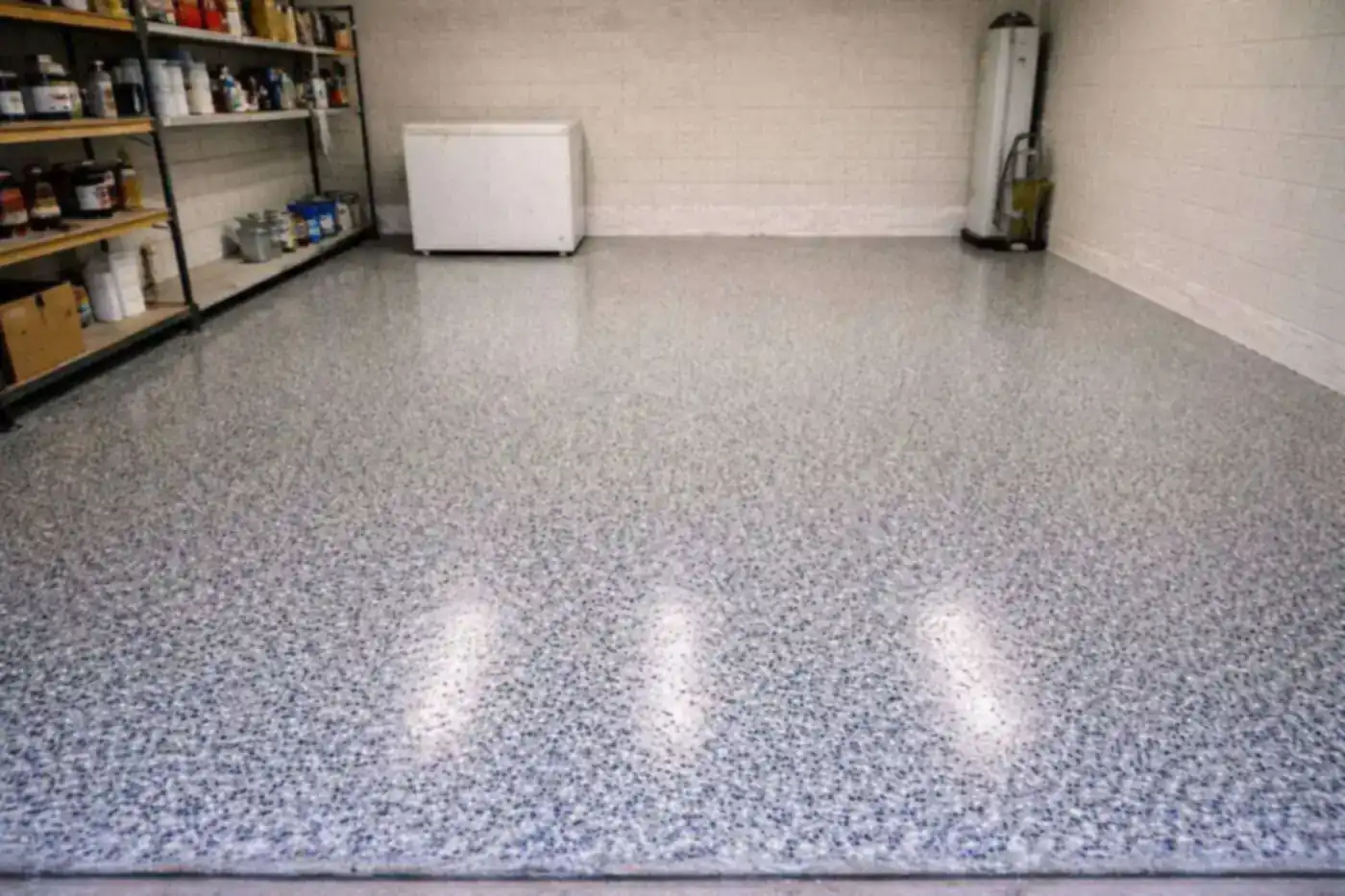
Short version: for most Houston garages, yes — as long as the slab is sound, the prep is done properly and the floor finishes with a UV-stable top coat. Skip any of those and the same money can buy a floor that starts lifting where the tires sit.
Greater Houston is slab country. About two-thirds of the homes in Fort Bend and Montgomery counties were built in 2000 or later, and newer homes here are commonly built on a slab, so the garage floor is usually bare concrete waiting for something better. It’s also a demanding climate for a floor: clay that moves, long hot summers, muggy mornings and a lot of rain. Here is how the pros and cons stack up against those conditions.
What Epoxy Does Well in a Houston Garage
It cleans up after rain and mud
Bush Intercontinental Airport averages about 51.8 inches of rain a year, and a garage floor gets its share of wet tires, mud and water blown in under the door. A coated floor is non-porous, so grime sits on top and wipes or hoses off instead of soaking into bare concrete. It isn’t waterproofing and won’t keep water out, but it makes the cleanup far easier.
It stands up to hot tires and spills
Bush Intercontinental logs about 111 days a year at 90°F or more, nearly all of them between May and October, so tires rolling in off hot pavement are a routine test. A system finished with a polyaspartic top coat is made to resist the softening and peeling known as hot-tire pickup. Oil drips and most household spills stay on the surface, where they wipe up, instead of soaking into raw concrete.
Color that holds in Gulf Coast sun
Plain epoxy can yellow under strong UV, and the airport gets about 70% of its possible sunshine in July. A garage that sits with the door open, a patio or a pool deck needs a UV-stable top coat over the epoxy. With it, the color holds up far better; without it, even a well-laid floor can turn dull and amber.
A room you’ll actually use
A flake or metallic finish turns a dusty garage into a bright space for a workbench, a home gym or a car you care about. That’s a real gain in usable space, even though, as the FAQ below explains, it doesn’t show up in an appraisal.
The Drawbacks, Plainly
It costs more than paint
A flake floor with a polyaspartic top coat runs about $2,000 to $4,500 for a typical 2-car garage in the Houston area, while a national cost guide puts a professionally painted 2-car floor at about $800 to $2,300. If paint fits the budget and epoxy doesn’t, waiting is a fair call.
Prep decides everything
A coating is only as good as its grip on the concrete: the surface ground open, the cracks filled and the moisture checked before anything is rolled out. When two quotes for “an epoxy floor” are far apart, the difference is often in that prep.
It can’t fix a moving slab
Much of Greater Houston sits on Lake Charles clay, a soil USDA scientists describe as opening dry-season cracks up to about 2 inches wide. Slabs above it often crack, and a crack that is still moving will come back through any coating. A moving slab is a foundation question, not a floor-coating one.
Humid days limit when it goes down
Coatings should be applied only when the slab is at least 5°F above the dew point, and Houston’s summer dew points average about 74°F. On a sticky morning a careful installer may hold off, so leave some flexibility in your plans.
It’s slick when wet
A glossy floor gets slippery with water on it, which matters on a patio, around a pool or where rain blows into the garage. A grit additive mixed into the top coat cuts the slip, so ask for it before the work starts.
Not Sure Epoxy Fits Your Floor?
Talk it through on the phone at any hour, or ask for a free quote online.
Epoxy Compared With Other Options
Here’s how the realistic choices compare, using typical Houston-area prices where local figures exist.
| Option | Typical Cost | Heat & Sun | Best For | Watch-Out |
|---|---|---|---|---|
| Flake epoxy + polyaspartic top coat | about $5 – $9 per sq ft | Handles both, thanks to the top coat | Most garages, patios | Needs real grinding and a moisture check |
| Solid-color epoxy | about $3 – $6 per sq ft | Can yellow without a UV-stable top coat | Workshops, storage | Plainer look; ask whether a top coat is included |
| Metallic epoxy | about $6 – $12 per sq ft | Needs a UV-stable top coat | Showpiece garages, slab interiors | Shows every slab flaw |
| Grind & seal | about $2.50 – $4 per sq ft | Depends on the sealer | Large plain floors, basic protection | No flake; a thinner layer than a full system |
| Painted floor (hired) | 2-car about $800 – $2,300 | Prone to hot-tire lifting | Tight budgets, short stays | Needs redoing sooner |
For most garages the flake system is the middle ground: more than a sealer or paint, less than metallic, and the one built to take hot tires and sun.
When Epoxy Is Worth It
- The slab is sound. Old, stable hairline cracks can be filled; a slab that is still moving needs attention first.
- You’re staying a while. The longer you use the floor, the better it compares with repainting.
- The garage works hard. Daily parking, a workshop or a gym gets the most from a surface that wipes clean.
- Heat and sun reach the floor. An apron, a patio or a garage door left open all afternoon is where a UV-stable top coat earns its place.
- There’s a slab to coat. Many newer homes around Greater Houston are built on one.
When It Isn’t Worth It
- The slab is still moving. Fresh or widening cracks in clay country will reappear through a new coating.
- You’re moving out soon. Epoxy floors don’t raise a home’s formal appraisal value, so a short stay rarely earns the cost back.
- The floors are wood. Many older inner-Loop homes, including most in the Houston Heights, are pier-and-beam, with no slab under the living areas.
- Water is coming up through the concrete. Coating over an active moisture problem invites peeling; test it and treat it first.
The Houston Verdict
Houston is hard on a cheap floor and kind to a well-built one. Clay that cracks slabs, humid mornings, long hot summers and heavy rain all punish a thin coat rolled over etched concrete. Those same conditions are where a ground, crack-filled, moisture-checked slab with a polyaspartic top coat pays off: it cleans up after water, stands up to hot tires and holds its color in the sun.
So the answer is yes for most garages on a sound slab, when you plan to stay and the quote includes real prep. To put numbers on your own floor, read the Houston cost guide, call (713) 360-0167 any time, or request a free quote online.
Frequently Asked Questions
Is epoxy flooring worth it for a Houston garage?
For most garages on a sound slab, yes. A flake floor with a polyaspartic top coat resists hot tires and stains, holds its color in strong sun and cleans up easily after rain. At about $2,000 to $4,500 for a typical 2-car, it makes the most sense if you’ll be in the home a while.
Is epoxy better than painting the garage floor?
For a floor you park on, usually. Paint costs less, about $800 to $2,300 for a hired 2-car job by national estimates, but it sits on the surface and is more prone to lifting under hot tires. An epoxy system bonds to ground concrete and adds a tougher top coat.
Does an epoxy floor add value to a Houston home?
Not on paper. A major national cost guide notes that epoxy floors don’t raise a home’s formal appraisal value. What it adds is a cleaner, more usable garage that can help a listing look cared for. Buy it for your own use, not as an investment.
Will an epoxy floor survive a flood?
No coating makes a garage flood-proof, and epoxy doesn’t waterproof a slab. A coated floor does clean up and disinfect more easily after water gets in. If a slab has flooded, it should be moisture-tested before any new coating goes down.
Is epoxy worth it if my slab has cracks?
Often, yes. Stable hairline cracks are common on Houston clay and get filled and ground flush during prep. A crack that is still widening will come back through any coating, so have it looked at before paying for a finish.
Can epoxy go down in Houston’s humidity?
Yes, with care. The slab should be at least 5°F above the dew point, so humid mornings can push the work later in the day. A moisture reading on the slab matters as much as the weather.